GPIQ vs DIY Covered Calls on QQQ: Income ETF vs Manual
For an income investor, the question with a covered call ETF is not just whether it pays a high distribution. It is whether that income comes at a reasonable cost in capped upside, drawdowns and risk-adjusted return.
To test that, we compared GPIQ against a grid of DIY covered call strategies on QQQ over the same 2-year period.
How to read the heatmap
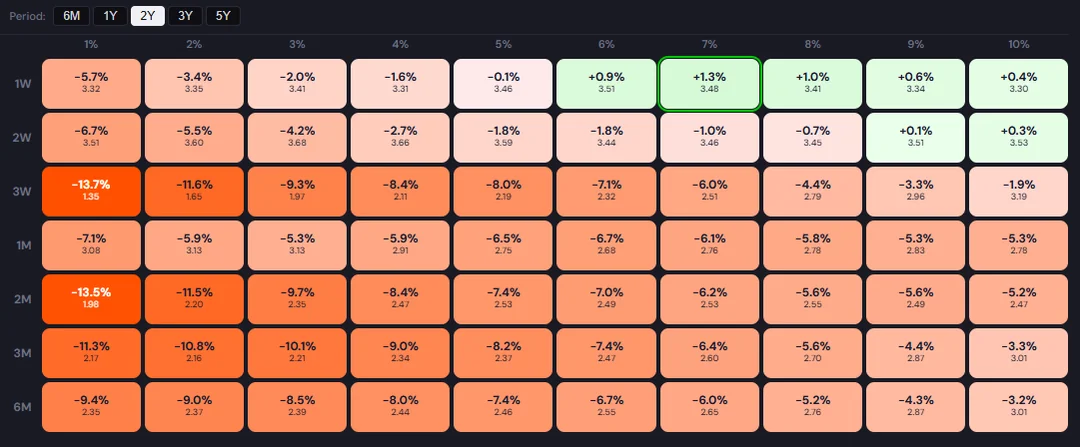
- each column is the strike distance from spot, from 1% to 10% out of the money;
- each row is the tenor, from 1 week to 6 months;
- the large number is the annualised return relative to simply holding QQQ;
- the smaller number is the monthly Sortino ratio.
GPIQ vs QQQ
Over the matched period:
| Total return | Annualised return | Monthly Sortino | |
|---|---|---|---|
| QQQ | +53.0% | about 23.6% | 3.67 |
| GPIQ | +50.7% | about 22.7% | 3.96 |
GPIQ stayed close to QQQ on total return, with less than 1% a year of drag, and had a higher monthly Sortino.
GPIQ vs the DIY grid
GPIQ outperformed 61 of the 70 DIY covered call configurations in the grid.
The DIY setups that did better were mostly short-dated and far out of the money: weekly or biweekly calls, roughly 8% to 10% OTM. Those cells are worth looking at, but they are also probably the most sensitive to real-world frictions: spreads, execution, taxes, frequent rolling and gap risk.
Takeaway
An income ETF with a conservative call-selling approach can be a fairly high bar for a simple mechanical DIY strategy, at least in a strong market where retaining upside matters.
This publication is provided for informational purposes only. It does not constitute investment advice, an offer or a recommendation to buy or sell any financial instrument. Past and simulated performance is not indicative of future results.
Historical backtest observations for research and education only. Not investment advice; past performance does not guarantee future results.
Run this analysis on any stock or ETF.
Join the Private Beta